President Trump Announces Global 10% Tariff
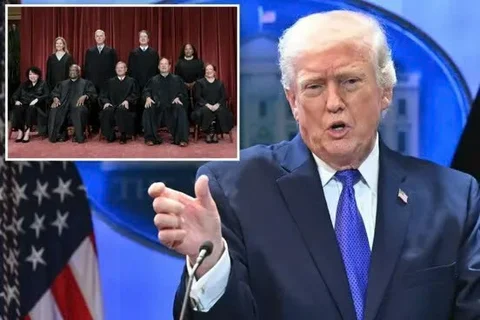
President Donald Trump has officially announced a 10% tariff on goods imported from all countries worldwide. This move comes immediately after the U.S. Supreme Court issued a ruling that limited or partially rejected the legal basis the Trump administration had used to justify previous tariff policies.
This latest decision creates a direct confrontation between the executive and judicial branches — two of the three pillars of the U.S. political system.
Power Struggle Between the White House and the Supreme Court
The Supreme Court's prior ruling had set clear limits on the President's authority to unilaterally impose tariffs without congressional approval. However, Mr. Trump declared that he would proceed with the new tariff policy, arguing that national economic security is a top priority.
This move raises a series of serious legal questions:
- Does the President have sufficiently broad executive power to impose global tariffs without congressional approval?
- How will the Supreme Court react to its ruling being disregarded?
- Will Congress be drawn into a legislative debate to amend current trade laws?
Impact on the Economy and Markets
Economic experts warn that a global 10% tariff would have numerous far-reaching consequences for the U.S. economy and international trade:
Expected increase in import prices: American consumers may face higher prices for goods across many sectors, from electronics and automobiles to food and daily consumer products.
Businesses face cost pressures: Companies reliant on international supply chains will confront significantly increased production and operating costs, particularly in manufacturing and technology industries.
Financial market volatility: Wall Street is likely to react negatively in the short term as investors re-evaluate global trade risks.
Anticipated International Reaction
Major U.S. trading partners, including the European Union, China, Japan, and Canada, are likely to implement retaliatory tariffs. This could plunge the world into a new cycle of trade wars, destabilizing the global economy which is already in a recovery phase.
The situation continues to be closely monitored as both Congress and legal organizations consider their next steps in response to President Trump's controversial decision.